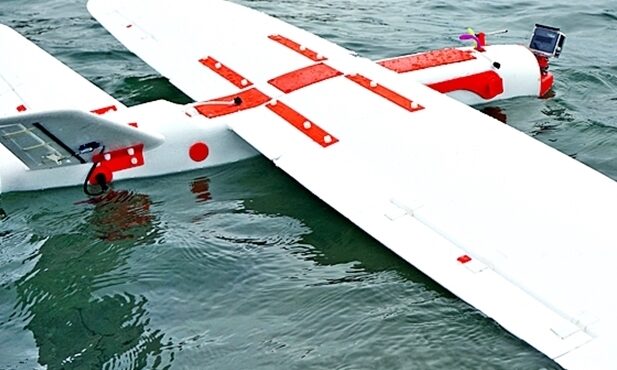
Can a drone really land on open ocean water and fly again afterwards? We hear this question constantly. And honestly, the answer isn’t as simple as most product pages make it sound. Plenty of brands stick the word “amphibious” on a drone that can handle, at best, a light splash in a calm pond. That’s a far cry from landing on real, rolling ocean swells, over and over, without something cracking or flooding out.
So let’s actually dig into this. Below, we’ll cover what it takes to build a genuinely amphibious drone, plus which one out there today can back that claim up with real numbers, not just marketing copy.
Why Landing on Open Ocean Water Is So Hard
Open water doesn’t behave like a runway. There’s no flat spot to aim for, nothing that holds still. The second a drone touches down, waves are already pushing and rolling underneath it. Add saltwater into the mix, and you’ve got something that eats through metal, wiring, and seals far faster than most engineers plan for.
Here’s the thing: most fixed-wing drones are built to belly-land on solid, flat ground. Drop that same design into the sea, and things go wrong fast: it sinks, it cracks on impact, or water sneaks in through a seam nobody thought to seal. Throw wind and salt spray into the equation, plus a moving ship deck as your only launch point, and you can see why so few drones on the market can honestly say they land on open ocean water and come back in one piece.
What Makes a Drone Truly Amphibious (Not Just Water-Resistant)
A drone that can actually survive open water needs more than a spray-resistant coating. Calling something an amphibious drone should mean it can take a real hit, not just shrug off a light drizzle. Every electronic component has to sit behind fully sealed housing, with gaskets built to keep saltwater out even after a rough landing. Corrosion resistance can’t be an afterthought either; it has to be part of the design from the very first sketch.
The body matters just as much, maybe more. A rigid shell will eventually crack under repeated impact. A foam airframe, on the other hand, we use EPP foam on our own builds, which flexes on impact and springs back into shape instead of shattering. It’s not really about staying afloat. It’s about surviving the same hit again and again without losing shape or letting water creep in.
There’s also a reason belly landings tend to beat floats or pontoons: fewer parts means fewer failure points. Pontoons add drag, extra weight, and one more component that can crack or take on water down the line. Out at sea, far from any repair bench, simple usually wins.
Curious why fixed-wing designs are also taking over large-scale mapping work on land? Worth a read if range and coverage matter to your work as much as water landings do.
The Drone That Answers This Question: VT-Naut
So which amphibious drone can actually pull this off? At Aeromao Inc., that’s the VT-Naut. It’s what we call a VTOSL drone, Vertical Takeoff and Short Landing, and it happens to be the first vertical takeoff fixed-wing drone in the world designed to land on water, saltwater included.
It lifts off straight up from a vessel deck or small boat. No launcher, no catapult, nothing extra needed. Once the mission wraps, it comes back down in a belly landing on the water, actually using the wave motion to shorten the landing rather than fighting it. Not a trick; this comes from years of real testing at sea, not a lab.
A few numbers, since specs matter here: wingspan close to two meters, up to 90 minutes of flight on one charge, telemetry range past 30 kilometres. The EPP body bounces back into shape after impact, so a rough landing doesn’t mean a wrecked drone.
It also handles a small, light payload, mapping cameras, video downlink gear, multispectral sensors, whatever the mission calls for. Every choice in this build comes back to one thing: real, repeatable landings on open ocean water.
Shipboard and Offshore Deployment: Launch and Recovery Made Simple
Landing any drone on a moving ship deck is brutal. Normally you need a net, a skyhook, or a crew member skilled enough to time the catch while the deck’s pitching underneath them and the wind is doing its own thing. Get the timing wrong, and you’re either damaging the drone or, worse, hurting someone on deck.
The VT-Naut just skips all of that. Since it lands on water instead of the deck, there’s no net, no hook, and no specialist training required. Launch straight up from the vessel, run the mission, bring it down on the water nearby, then pick it up by boat or by hand. Simple.
That alone cuts a major risk and cost out of offshore drone work, and it means a smaller crew can now run missions that used to need a full deck team on standby.
Maritime Surveillance and Coastal Patrol Applications
Coastal patrol and maritime surveillance both demand long range and steady coverage over water that never sits still. Hovering drones burn through battery fast and can’t cover much ground before turning back. A fixed-wing drone built for BVLOS flight can cover long stretches of coastline or open sea in one flight.
This is exactly where an amphibious drone earns its place in coastal defence and border work. It flies well past the pilot’s line of sight, holds a steady scan pattern, and lands safely right on the water it’s watching, instead of turning back to shore between checks. For a team running long coastal shifts, that alone can save hours every week.
Fighting Illegal Fishing and Supporting Ocean Monitoring
Illegal fishing tends to happen far from shore, in spots patrol boats can’t reach fast enough. A long-range amphibious drone changes that math. It scans wide stretches of protected marine water in one flight and flags boats that shouldn’t be there.
At Aeromao Inc., we’ve been part of real field operations targeting illegal fishing in protected marine zones, using our own water-landing fixed-wing drones to cover ground patrol boats alone simply couldn’t manage in the same window of time.
Open water is hard to watch from a single boat, but a drone flying a set pattern overhead spots activity well before a patrol crew gets close. Work like this needs an amphibious drone that can launch fast, fly far, and land safely once the job’s done.
Marine Research, Conservation, and Search and Rescue
Marine researchers and conservation teams often need to reach places that are tough to get to by boat: remote reefs, open-water wildlife zones, that kind of thing. A drone that lands directly on the water opens up sample areas and survey sites that would otherwise eat hours of travel time, all without disturbing the site itself.
The same qualities matter for offshore search and rescue. When time is short, a drone that launches fast, covers distance quickly, and lands near a target site without a runway gives rescue teams a real edge. Every minute spent setting up gear is a minute lost, and an amphibious drone cuts that setup time down close to zero.
Final Thoughts
Being water-resistant and being truly amphibious aren’t the same thing. A real amphibious drone is built from the ground up to survive actual ocean landings, again and again, without falling apart. Sealed compartments, a foam body that takes repeated hits, and a belly landing design that keeps things simple, that’s what separates a drone that can genuinely handle the open sea from one that just claims to on a spec sheet.
At Aeromao Inc., we built the VT-Naut to that exact standard, backed by a 12-month warranty, unlimited after-sales support, and every single unit flight-tested before it ever reaches you. If your work needs a drone that can launch off a deck, fly far, and land safely on open water, reach out to Aeromao Inc. Let’s figure out what fits your mission.
Frequently Asked Questions
Can a drone actually land on saltwater without damage?
Yes, but only if it’s built for it. That means sealed electronics, corrosion-safe parts, and a body that can take repeated impact, like the EPP build on the VT-Naut.
What does VTOL mean?
VTOL stands for Vertical Takeoff and Short Landing. The drone lifts straight up, flies like a normal fixed-wing plane, then comes down in a short belly landing.
Do I need a launcher or runway to fly an amphibious fixed-wing drone?
Nope. A VTOSL drone, like the VT-Naut, launches straight up from a small boat or ship deck, so there’s no catapult, launcher, or runway required.
How long can an amphibious drone like the VT-Naut stay in the air?
Up to 90 minutes per charge, with a telemetry range past 30 kilometres, plenty for most coastal and offshore missions.
Is an amphibious drone useful for search and rescue at sea?
Yes. Fast launch, long range, and the ability to land near a target site without needing a runway make it a strong fit for time-sensitive offshore search and rescue work.